Thirteen tracks in 63 minutes. Recorded across approximately five years (1992-1996) by Josh Davis (DJ Shadow) on an Akai MPC 60 sampler at Mo' Wax's Sheet One studio in San Francisco and at the Sacramento basement of Davis's parents. Released by James Lavelle's UK-based Mo' Wax label as the first album in history constructed entirely from samples, per the Guinness Book of World Records 2001 entry. The album that consolidated turntablism-and-sample-collage as a sustained instrumental LP form and inaugurated the home-listening downtempo electronic vocabulary every subsequent instrumental hip-hop LP has worked within.
- Released
- November 19, 1996 (UK); September 16, 1997 (US)
- Label
- Mo' Wax (UK, MW059LP); FFRR / London (US, 422-828 671-1)
- Producer(s)
- DJ Shadow (Josh Davis)
- Runtime
- 63:25 (13 tracks)
- Chart peak (US)
- #37 (Heatseekers)
- Chart peak (UK)
- #17
- Certifications
- Silver (BPI, 2014)
- Awards & honours
- Guinness Book of World Records (2001), 'first album in history constructed entirely from samples'; ranked #339 on Rolling Stone's 500 Greatest Albums (2020); routinely cited as the canonical instrumental hip-hop / trip-hop LP of the 1990s
Thirteen tracks in 63 minutes. Recorded across approximately five years (1992-1996) by Josh Davis (DJ Shadow) on an Akai MPC 60 sampler at Mo' Wax's Sheet One studio in San Francisco and at the Sacramento basement of Davis's parents. Released by James Lavelle's UK-based Mo' Wax label as the first album in history constructed entirely from samples, per the Guinness Book of World Records 2001 entry. The album that consolidated turntablism-and-sample-collage as a sustained instrumental LP form and inaugurated the home-listening downtempo electronic vocabulary every subsequent instrumental hip-hop LP has worked within.
Josh Davis (DJ Shadow) in 1992 was twenty years old, a Davis (CA) hip-hop DJ and producer who had been releasing tracks on Hollywood BASIC Records and the Solesides collective (with Lyrics Born, Lateef the Truthspeaker, Chief Xcel of Blackalicious). His early releases, 'Lesson 4' (1991), 'In/Flux' (1993), 'What Does Your Soul Look Like' (1994), had developed the sample-collage vocabulary that would define Endtroducing. The Hollywood BASIC and Solesides connections gave him access to substantial sample-source vinyl collections; his Sacramento parents' basement housed an estimated 60,000 LPs across the recording period.
James Lavelle had founded Mo' Wax Records in London in 1992 with substantial backing from A&M Records' UK arm. Lavelle had been the UK DJ-set scene's most-influential underground figure across 1993-95; Mo' Wax signed DJ Shadow in early 1994 based on the 'In/Flux' single and the 'Influx EP' material. The contract called for an LP within twenty-four months. Davis began assembling tracks for the album in earnest in mid-1994; sessions extended through summer 1996.
The album's central methodological decision was to construct every sound from samples, no original instrumental performance, no live recording, no synthesizer-original sounds. The MPC 60 sampler held the album's sample library; Davis estimated in subsequent interviews that the final album contains approximately 200 distinct sample sources across the thirteen tracks. The sample-only construction was the album's specific aesthetic argument: that the sample-collage form could sustain a coherent artistic statement across album-length runtime without any conventional instrumental performance.
The record does not argue, which is why the argument carried. 'Building Steam with a Grain of Salt' opens on a David Axelrod figure and a Pekka Pohjola loop and spends six and a half minutes declining to resolve into a beat. 'Midnight in a Perfect World' suspends a Meredith Monk vocal over a half-time pattern, and it is the track everyone cites because it is the one where the method disappears into the music. The two long pieces, 'Stem / Long Stem' at 9:23 and 'Napalm Brain / Scatter Brain' at 9:11, are built in movements rather than verses. Three of the thirteen tracks run under a minute. The sequencing asks to be heard end to end, which in 1996 was its own claim about what instrumental hip-hop was for.
The texture is a consequence of the machine. Every sound came off a single Akai MPC 60, whose 12-bit sampling resolution and filter behaviour give the album its grain, and roughly 200 distinct sample sources were layered through it across the thirteen tracks. The library behind that was a basement in Davis, California holding an estimated 60,000 LPs. Many of those samples were uncleared when the record came out. Clearance negotiations ran through the 2000s and some tracks have been altered for particular international releases, so certain later pressings no longer contain the album as it was released. The Guinness citation is narrower than it sounds: it recognises the first commercially released album built entirely from samples, and musique concrete and early hip-hop got there first in method if not in form.
Mo' Wax released the album on November 19, 1996 in the UK; FFRR / London released in the US on September 16, 1997. UK chart entry at #17 was substantial for an instrumental electronic LP of the period; US chart entry was #37 on the Heatseekers chart. The album sold approximately 250,000 UK units by 2000 and approximately 800,000 worldwide lifetime. Critical reception was extraordinary, NME named it the best album of 1996; Pitchfork's retrospective ranking placed it among the canonical instrumental electronic LPs of the 1990s.
Endtroducing belongs at #95 because it is the album that consolidated turntablism-and-sample-collage as a sustained instrumental LP form. Every subsequent instrumental hip-hop / downtempo LP (Mo' Wax's broader catalogue, Ninja Tune's catalogue, the trip-hop tradition's instrumental cuts, the lo-fi-study-music genre that emerged in the 2010s) descends from the proof Endtroducing delivered. The Guinness Book of World Records 2001 entry, 'first album in history constructed entirely from samples', and the Rolling Stone 2020 #339 ranking ratify the institutional standing.
Pressing guide — the one to own
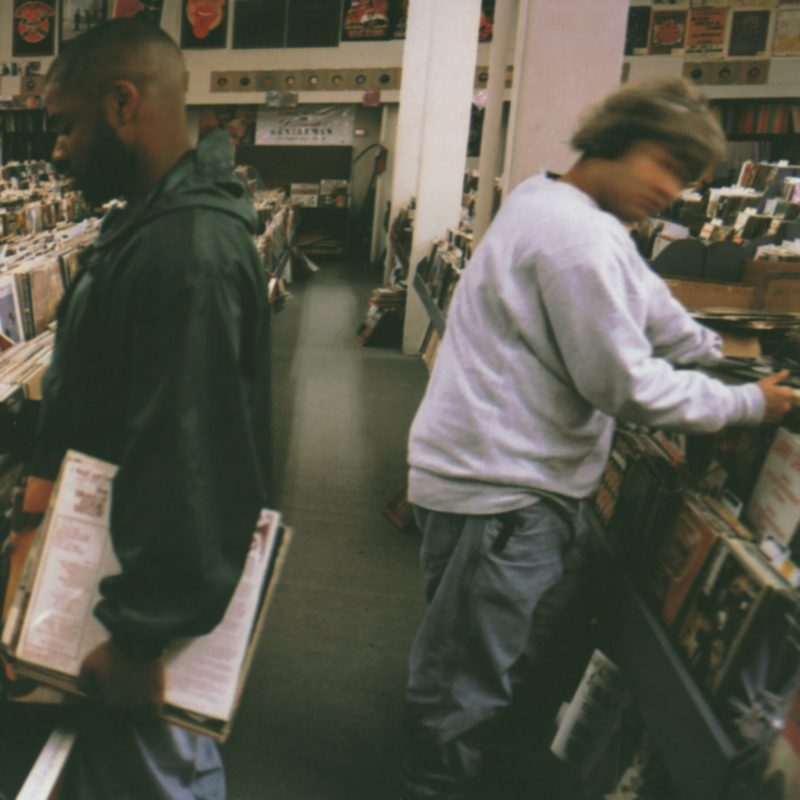
Original 1996 UK pressing, Mo' Wax MW059, a double-LP in a gatefold sleeve. The cover photograph, two crate-diggers in a Sacramento record store, was shot by Brian Cross (B+), with sleeve design by Ben Drury, not 'Ben Stokes'. Both a gatefold-opening-outside and an opening-inside variant of the original exist. Confirm the Mo' Wax MW059 catalogue number and the original gatefold to separate a first press from the later reissues.