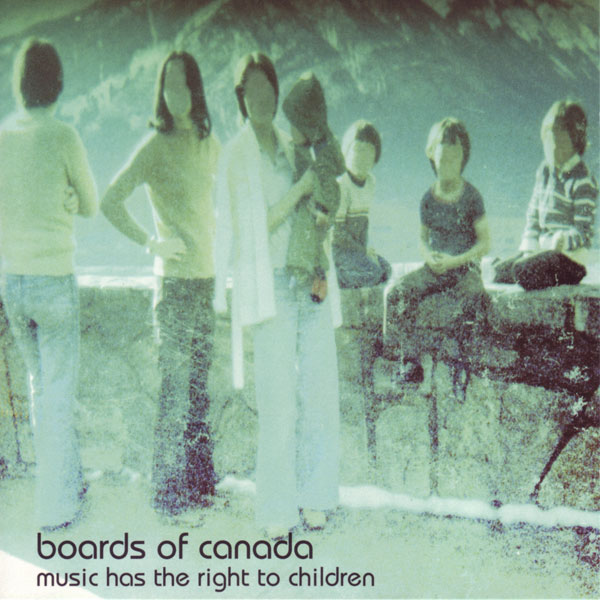
Seventeen tracks in 65 minutes. Recorded across approximately four years at Hexagon Sun studio in the Pentland Hills outside Edinburgh by brothers Michael Sandison and Marcus Eoin (Boards of Canada). Released by Warp Records and Skam Records in April 1998 as a joint imprint release. The album that consolidated tape-warble nostalgia-electronic as a sustained commercial-pop form and inaugurated the home-listening ambient-techno vocabulary every subsequent twenty-first-century downtempo electronic LP has worked within.
- Released
- April 20, 1998
- Label
- Warp Records / Skam Records (UK, WARPLP55)
- Producer(s)
- Michael Sandison · Marcus Eoin
- Runtime
- 65:43 (17 tracks)
- Chart peak (US)
- Did not chart
- Chart peak (UK)
- Did not chart on initial release; #145 on 2014 reissue
- Certifications
- Silver (BPI, 2021)
- Awards & honours
- Ranked #357 on Rolling Stone's 500 Greatest Albums (2020); routinely cited as the canonical IDM LP of the late 1990s
Seventeen tracks in 65 minutes. Recorded across approximately four years at Hexagon Sun studio in the Pentland Hills outside Edinburgh by brothers Michael Sandison and Marcus Eoin (Boards of Canada). Released by Warp Records and Skam Records in April 1998 as a joint imprint release. The album that consolidated tape-warble nostalgia-electronic as a sustained commercial-pop form and inaugurated the home-listening ambient-techno vocabulary every subsequent twenty-first-century downtempo electronic LP has worked within.
Michael Sandison and Marcus Eoin (the Boards of Canada brothers, Eoin took the surname later) in mid-1994 were in their early-to-mid twenties, Edinburgh-raised, with substantial home-recorded electronic-music catalogue across the previous decade. The duo had been releasing material under various names through small Scottish underground labels since 1986. The Boards of Canada project crystallized around 1994 with the 'Twoism' EP; subsequent releases on Skam Records (Manchester) established the duo's underground reputation.
Sessions for Music Has the Right to Children extended approximately four years across 1994-1998 at the duo's Hexagon Sun studio in the Pentland Hills outside Edinburgh. The studio was a custom-built facility with substantial vintage-equipment focus: Roland TR-606 and TR-808 drum machines, multiple Roland Juno polysynths, a Roland D-50, vintage Yamaha DX7, and substantial tape-machine equipment for the 'tape-warble' aesthetic. The duo's central production decision was to process every electronic sound through tape, vintage cassette deck or reel-to-reel, to introduce the tape-warble pitch-and-tempo instability that defines the album's specific sonic texture.
Warp Records co-released the album with Skam Records in April 1998. The Warp / Skam joint imprint was unusual, Warp had launched its 'Artificial Intelligence' compilation in December 1992 and had developed the 'IDM' / home-listening-electronic category extensively; Skam was a small Manchester label with substantial cult underground reputation. The joint release positioned Boards of Canada as both Warp-affiliated (commercial-pop electronic-LP reception) and Skam-affiliated (underground experimental electronic-LP reception).
Seventeen tracks, and the shape of the thing matters as much as any one of them. Five run under two minutes and function as breathing space rather than as songs; the weight sits in 'An Eagle in Your Mind' at 6:23, 'Telephasic Workshop' at 6:35, 'Rue the Whirl' at 6:39 and 'Pete Standing Alone' at 6:07. 'Roygbiv' is two and a half minutes and has become the most widely borrowed thing on the record. The album was built at Hexagon Sun, a converted farm building the Sandisons equipped in the Pentland Hills outside Edinburgh, and the remoteness was the point rather than a constraint.
The central production decision was to run every electronic sound through analogue tape, cassette or reel-to-reel, to introduce the pitch and tempo instability the record is now identified by. Tape degradation was not new; experimental musicians had used it for decades. What was new was applying it systematically as the defining surface of a whole album, over a palette of vintage National Film Board of Canada documentary samples, late-1970s children's television audio and mathematics-class instructional recordings. The album did not chart in 1998. It reached UK #145 on the 2014 Warp reissue, sixteen years after release, which is a fair measure of how its standing was built: not by sales, but by a generation of producers taking the surface apart.
The album's central artistic decision was the deliberate nostalgia-aesthetic. Vintage National Film Board of Canada documentary samples, late-1970s children's-television show audio, mathematics-class instructional audio, vintage analog-synthesizer texture, the tape-warble pitch instability, all combine to produce what the duo has called 'the feeling of a hot childhood afternoon.' The nostalgia aesthetic is the album's specific commercial-cultural argument: that electronic music could function as a sustained meditation on memory rather than on the future-orientation that had dominated 1990s electronic-music aesthetics.
Critical reception was extraordinary and unanimous. Pitchfork's Brent Sirota gave the album 9.6/10; NME's Stevie Chick treated it as the canonical IDM LP of the late 1990s. The album didn't chart on initial release but reached UK #145 on the 2014 Warp reissue. Streaming-era catalogue presence has been sustained; BPI Silver certification came in 2021 (twenty-three years after release).
Music Has the Right to Children belongs at #97 because it is the album that consolidated tape-warble nostalgia-electronic as a sustained commercial-pop form and inaugurated the home-listening ambient-techno vocabulary every subsequent twenty-first-century downtempo electronic LP has worked within. Every subsequent ambient-electronic LP that takes vintage-equipment processing as a deliberate aesthetic decision, Burial, Tycho, Caribou's earlier catalogue, Nicholas Jaar, Oneohtrix Point Never, every lo-fi study-music release, descends from the Boards of Canada precedent. The Rolling Stone 2020 #357 ranking ratifies the canonical-text status.
Pressing guide — the one to own
Original 1998 UK pressing, Warp/Skam WARPLP55, a double LP in a gatefold sleeve, with 'SKAM / WARPLP 55' in the runouts. The first press is prized for its sound. The parallel US issue was distributed by Matador (ole 299-1), typically with a Matador barcode sticker over the original. Confirm the WARPLP55 catalogue number and the original gatefold to separate a first press from the later reissues.