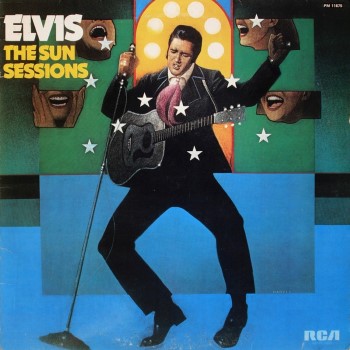
What a copy of The Sun Sessions is worth
Estimated market value of an original pressing of The Sun Sessions by
Elvis Presley, by sleeve and media condition on the Goldmine grading scale.
- Mint (M)
- £60–£120 (original Sun 78s: £1000+)
- Very Good Plus (VG+)
- £30–£50
- Very Good (VG)
- £12–£22
The pressing to look for: 1976 US, RCA APM1-1675 (first pressing). Catalogue number RCA APM1-1675.
Researched market ranges for the original pressing; condition,
completeness of inserts and pressing variant all move the figure. The Lead-In values
every record against live marketplace data — value your own
shelf for a current, condition-matched figure.
Sixteen tracks of 1954-55 recordings. Compiled and released in 1976 as a chronological compilation of Elvis Presley's Sun Records recordings made between July 1954 and November 1955 at Sun Studio in Memphis with Sam Phillips producing. The recordings that introduced rock and roll's commercial vocabulary and provided the template every subsequent rock and roll LP has worked within.
- Released
- March 1976 (compilation; recordings made July 1954, November 1955)
- Label
- RCA Victor (US, APM1-1675)
- Producer(s)
- Sam Phillips (original recordings) · Joan Deary (1976 compilation)
- Runtime
- 39:48 (16 tracks)
- Chart peak (US)
- #76 (Billboard 200, 1976 reissue)
- Chart peak (UK)
- Did not chart
- Certifications
- Gold (RIAA, 1992)
- Awards & honours
- Library of Congress National Recording Registry (the original Sun Sessions, 2002); Rolling Stone's 500 Greatest Albums (2020 ranking)
Sixteen tracks of 1954-55 recordings. Compiled and released in 1976 as a chronological compilation of Elvis Presley's Sun Records recordings made between July 1954 and November 1955 at Sun Studio in Memphis with Sam Phillips producing. The recordings that introduced rock and roll's commercial vocabulary and provided the template every subsequent rock and roll LP has worked within.
Elvis Aaron Presley in summer 1954 was nineteen years old, a Memphis truck driver who had walked into Sun Studio in summer 1953 to record a demo for his mother's birthday. Sam Phillips, the Sun Studio founder and producer who had been recording African-American R&B artists (B.B. King, Howlin' Wolf, Junior Parker) since 1950, had been searching for a white singer who could perform with deliberately-Black musical vocabulary. Phillips hired guitarist Scotty Moore and bassist Bill Black; the trio's first session on July 5, 1954 produced 'That's All Right', the recording that is widely cited as rock and roll's founding text.
Recording extended across approximately seventeen months from July 1954 to November 1955. Phillips's working method was deliberately-controlled: he would prepare backing tracks with Moore and Black, then bring Elvis in for the vocal sessions. The deliberately-rhythmic combination (Elvis's deliberately-Black-influenced vocal delivery over Moore's deliberately-country guitar and Black's deliberately-rockabilly bass) produced rock and roll's specific sonic signature.
The Sun Sessions recordings introduced rock and roll's commercial vocabulary. The deliberately-Black-American vocal approach combined with deliberately-country instrumentation and deliberately-uptempo arrangements consolidated the genre as a commercially-viable register. Every subsequent rock and roll LP, from Chuck Berry's late-1950s recordings through Buddy Holly's debut to the Rolling Stones' early covers to the Beatles' Cavern Club performances, operates within the vocabulary the Sun Sessions established.
RCA Victor compiled and released the Sun Sessions in March 1976 as a deliberately-chronological compilation of the 1954-55 recordings; the compilation was Joan Deary's contribution to RCA's deliberately-historical Elvis catalogue management. The compilation peaked at US #76 in 1976, modest commercial reception but substantial historical-archival significance.
The Sun Sessions belongs at #72 because it is the compilation that consolidated rock and roll's founding text and provided the template every subsequent rock and roll LP has worked within. The Elvis-Phillips-Moore-Black template for rock and roll has been continuous since 1954. The Library of Congress inducted the individual Sun Sessions recordings (specifically 'That's All Right') into the National Recording Registry in 2002, confirming a position the music itself had secured by the end of 1955.
Pressing guide — the one to own
This compilation first appeared in the UK in 1975 as 'The Elvis Presley Sun Collection' (RCA Starcall HY 1001), then was retitled for its 1976 US issue as 'The Sun Sessions' on RCA Victor, catalog APM1-1675, a mono single-sleeve LP with the tan RCA label. As a 1970s comp it holds modest collector value; the genuine grails are the five original 1954-55 Sun singles (Sun 209 'That's All Right' through Sun 223 'I Forgot to Remember to Forget'), issued on both 78 and 45 RPM, with Sun 209 commanding four-to-five figures in clean condition.