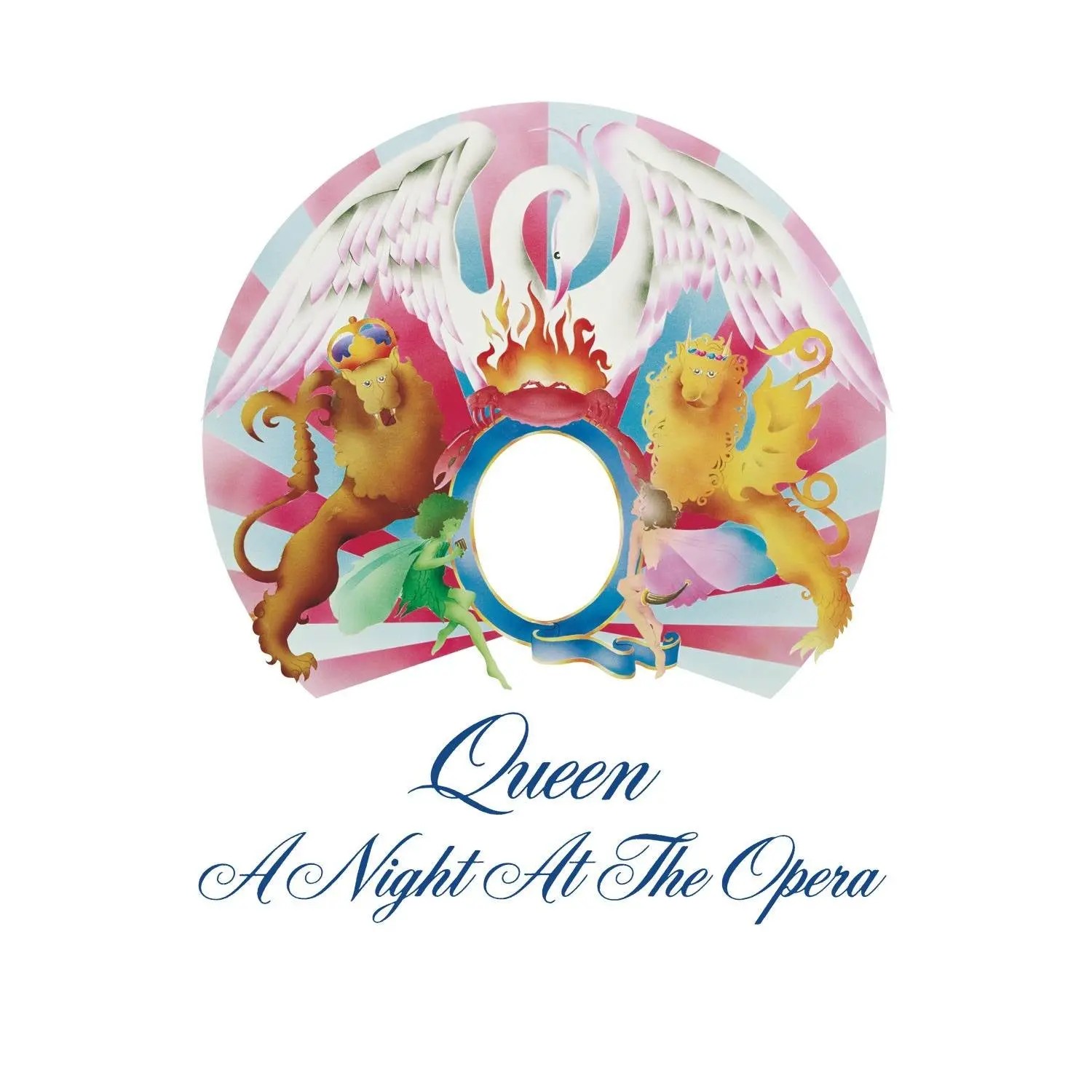
Queen's fourth album, recorded in 1975 across six studios on 24-track tape. The best-made record of their career, with a first side that never settles into a shape.
- Released
- 28 November 1975 in the UK, by the BPI's record (EMI EMTC 103; the label's history site and the catalogue entry give 21 November); December 1975 in the US (Elektra 7E-1053)
- Label
- EMI (UK); Elektra (North America)
- Producer(s)
- Roy Thomas Baker and Queen
- Runtime
- 43:01
- Chart peak (US)
- #4 (Billboard Top LPs & Tape), 3 weeks from the chart dated 17 April 1976
- Chart peak (UK)
- #1 (Official Albums Chart), 4 weeks at the top; Queen's first UK #1 album
- Certifications
- RIAA 3× Platinum (14 November 2002); BPI Platinum (1976)
- Awards & honours
- 'Bohemian Rhapsody': best British single of the previous 25 years at the BPI's 1977 awards, shared with Procol Harum's 'A Whiter Shade of Pale'. Voted Britain's favourite single in a 2002 Guinness poll
A Night at the Opera was built in sections and joined in the studio, and the joins are its glory. The same habit is its flaw: a superb side two, sequenced like a concert, follows a side one that plays like a variety bill.
At his flat in Kensington, Freddie Mercury sat at the piano and played Roy Thomas Baker the opening ballad of 'Bohemian Rhapsody'. Then he stopped. 'This is where the opera section comes in,' he said, as Baker told Sound on Sound in 1995. Both men burst out laughing, and they went out to dinner. Baker had worked with the D'Oyly Carte Opera Company at Decca. He reckoned he was one of the few people in the world who knew exactly what Mercury meant.
That joke at the piano is the album in small. A Night at the Opera is a record of sections joined in the studio, and the joins are where it lives. It's the best-made record Queen ever released, the point where Baker's methods and the band's ambition met at full stretch. It's also a record that never quite settles on what it is. Side two is sequenced like a concert. Side one plays like a variety bill. That's the price of the method. It's worth paying, but it's a real price.
It was made at a turning point in the band's business. Queen had signed to Trident Audio Productions, the production company run from the studio where Baker had made his name. The gatefold of this album still carries Trident's name. Sheer Heart Attack had reached #2 in Britain in late 1974, and 'Killer Queen' had been a #2 single. By the time the new record was finished, the band had a new manager, John Reid, and the sleeve credits him. Their British tour opened in Liverpool on 14 November 1975, and the album was finished only shortly before it.
Something sour went straight onto the record. 'Death on Two Legs' opens the album as an attack on a former business associate, and the gatefold prints its dedication with no name after it. The band let more than a minute of instrumental intro pass before Mercury sings a word, at 1:05. So the first thing you hear him say on Queen's grandest album is a grudge. That's a strange way to open a record built on craft, and a revealing one. Baker's own brief was plainer. 'As always, I was out to make the best record possible,' he said. He'd been given a start date and a deadline for the whole album, and nothing else.
Recording began at Rockfield, near Monmouth, on 24 August 1975. The sleeve lists six studios in all, the other five in London, and the album was mixed at Sarm. It was Queen's first album on 24-track tape. The first three had been made on 16. The budget is less certain than its fame. The album is often called the most expensive ever made at the time, at about £40,000. The BBC's review repeated the claim in 2007, and Louder in 2026 said it 'reputedly' cost that much. No primary figure exists. Sound on Sound reported in 1995 that the cost of recording 'Bohemian Rhapsody' alone could no longer be traced. Baker thought it must have been very expensive, but money wasn't his department.
'Bohemian Rhapsody' shows how the method worked. At Rockfield the band recorded the ballad and the hard-rock section as separate backing tracks, Baker said. Between them they left a strip of blank tape about 30 seconds long for the opera. Every time Mercury came up with another 'Galileo', Baker spliced in more tape, until the reel looked like a zebra crossing. That went on for 3 or 4 days. The opera section then took about 3 weeks to record, which Baker said was as long as most bands spent on a whole album. He built each harmony part from 3 tracks, bounced them down to one, then bounced again. One part ended up eight generations from the original. Gary Langan, an 18-year-old assistant at Sarm, then joined the three sections into one master. Nobody knew how the whole song sounded until he'd spliced it together.
Listen to the last few seconds of the opera section, just before 4:00, and you can hear what that cost. The voices are rough at the edges. Baker said the distortion on them was 'very, very high', and he blamed two things. One was the bouncing. The other was the automation fitted to Sarm's desk only days before the mix. It was an old VCA system, in Baker's words, and its circuits couldn't take any more by that point. So they switched it off and mixed the hard-rock section by hand, each of them riding a fader or a group of faders. That's why the cut into the rock section, a few seconds after 4:00, lands so clean and so loud. The song's most exciting moment is partly a repair job, and it's better for it.
The rest of the record uses the same tools on smaller jobs. In the bridge of 'Seaside Rendezvous', from 0:54, the brass and woodwind are voices. The sleeve credits Mercury with the woodwind and Roger Taylor with the brass. Universal's uDiscover history adds that the tap dancing was done on the mixing desk, with thimbles on their fingers. On 'Good Company' May sings lead and credits himself with a 'Guitar Jazz Band', a trad-jazz line-up made from his own guitar. The sleeve announces 'No Synthesisers!' Baker explained that it was there because people kept mistaking the layered guitars for synthesisers. This is production as invention. The odd sounds on this record were made by hand, and you can tell.
Side two is where the ambition pays off in full. It opens with 'The Prophet's Song', at 8:21 the longest track on the album, with May credited on the sleeve for toy koto. Then comes 'Love of My Life', Mercury at the piano with May on harp. It outlived the album: a live version from Live Killers was a British single in 1979. 'Good Company' is a breather before 'Bohemian Rhapsody', and May's guitar arrangement of the national anthem closes the record. Those 22 minutes rise and fall like a well-planned set.
Side one is the problem. In about 20 minutes it runs through seven songs, from music hall to heavy rock. Each one is well made. Together they don't add up to a mood. 'Sweet Lady' is the weakest of them. It's May's heavy rocker, all riff and little song, and next to everything around it, it sounds like filler. The doubt was there at the time. Robert Christgau gave the album a B− in the Village Voice in March 1976. He granted that it didn't botch any of its styles, then asked for 'a coherent masterwork'. In 2016 Mark Blake's ranking for Louder put 'Lazing on a Sunday Afternoon' last of the 12 tracks and 'Good Company' 11th.
The frustrating thing is that side one holds some of the best songs. 'You're My Best Friend' is John Deacon's second song for the band and the first of his to be a Queen single. He plays electric piano on it, and it reached #7 in Britain in 1976. ''39' is May singing his own science-fiction song about space travel, with Deacon on double bass. Baker thought most of the band's arguments were about who got the B-side, and the royalties that came with it. Taylor wanted 'I'm in Love with My Car' on the back of 'Bohemian Rhapsody' so badly that he locked himself in the tape closet at Sarm. He said he wouldn't come out until the others agreed. The song became the B-side. All four writers get their moment. Nobody arranged those moments into a shape.
What the album changed, it changed mostly through its single. EMI doubted that radio would play anything over about 3½ minutes, Baker said. He had his own precedents in mind: 'MacArthur Park' and 'Eloise', two long hits from 1968. Baker and the band wanted an outside opinion, so they played it to Kenny Everett of Capital Radio, whose studio was round the corner from Scorpio. Everett loved it. Over a curry afterwards he asked for a copy, and they gave him a reel-to-reel on a promise not to play it. He played it 14 times over the weekend, and fans tried to buy it the following Monday. Released on 31 October 1975, the single entered the chart at #47 on 8 November. Bruce Gowers shot a promo for it at Elstree in about 4 hours, so the band wouldn't have to mime it on Top of the Pops. From 29 November it spent 9 weeks at #1. On the Christmas chart Queen had the #1 single and the #1 album at once.
The album's standing has held. In 2007 the BBC's Chris Jones called it the band's finest hour. Reviewing the 2011 reissues for Pitchfork, Dominique Leone wrote that it was Queen at the top of the mountain. In 1992 Greg Kot of the Chicago Tribune gave it 3 stars, the same as A Day at the Races, and called the two together the band's artistic peak. In 2002 more than 31,000 people voted in a Guinness poll, and they chose 'Bohemian Rhapsody' as Britain's favourite single, ahead of 'Imagine'. It's still the only single to be the UK's Christmas #1 twice: in 1975, and in 1991 after Mercury's death. What's harder to find is a later artist who credits the album itself, rather than its single. Its documented legacy runs through one song more than through the record as a whole. But that song is on the record, and it proved that a 6-minute single could be the biggest in the country.
Judged as record-making, A Night at the Opera is as good as 1970s British rock gets. Queen never made a better-sounding album, and Baker never pushed tape harder. Judged as an album, it's a superb side two behind a side one that plays like a revue. 'Sweet Lady' is filler, and the music-hall miniatures are charming but slight. None of that stops it being essential. It's a great record with a seam down the middle, and you can hear exactly where it was stitched.
Pressing guide — the one to own
The original to own is the 1975 UK first issue on EMI, EMTC 103, in its embossed matte gatefold with the lyrics inside and a printed card picture inner sleeve. Its matrices are YAX 5063 and YAX 5064, with Chris Blair's BLAIR'S etched in the runout. That etching isn't enough on its own, because represses carry it too. A first issue has no 'Crest design © Queen Productions Ltd 1975' caption on the front, and its inner sleeve has three die-cut corners. In the US the original is Elektra 7E-1053, pressed at several plants in 1975, including Santa Maria (CSM), Specialty (SP), Pitman (CP) and Terre Haute (CTH).