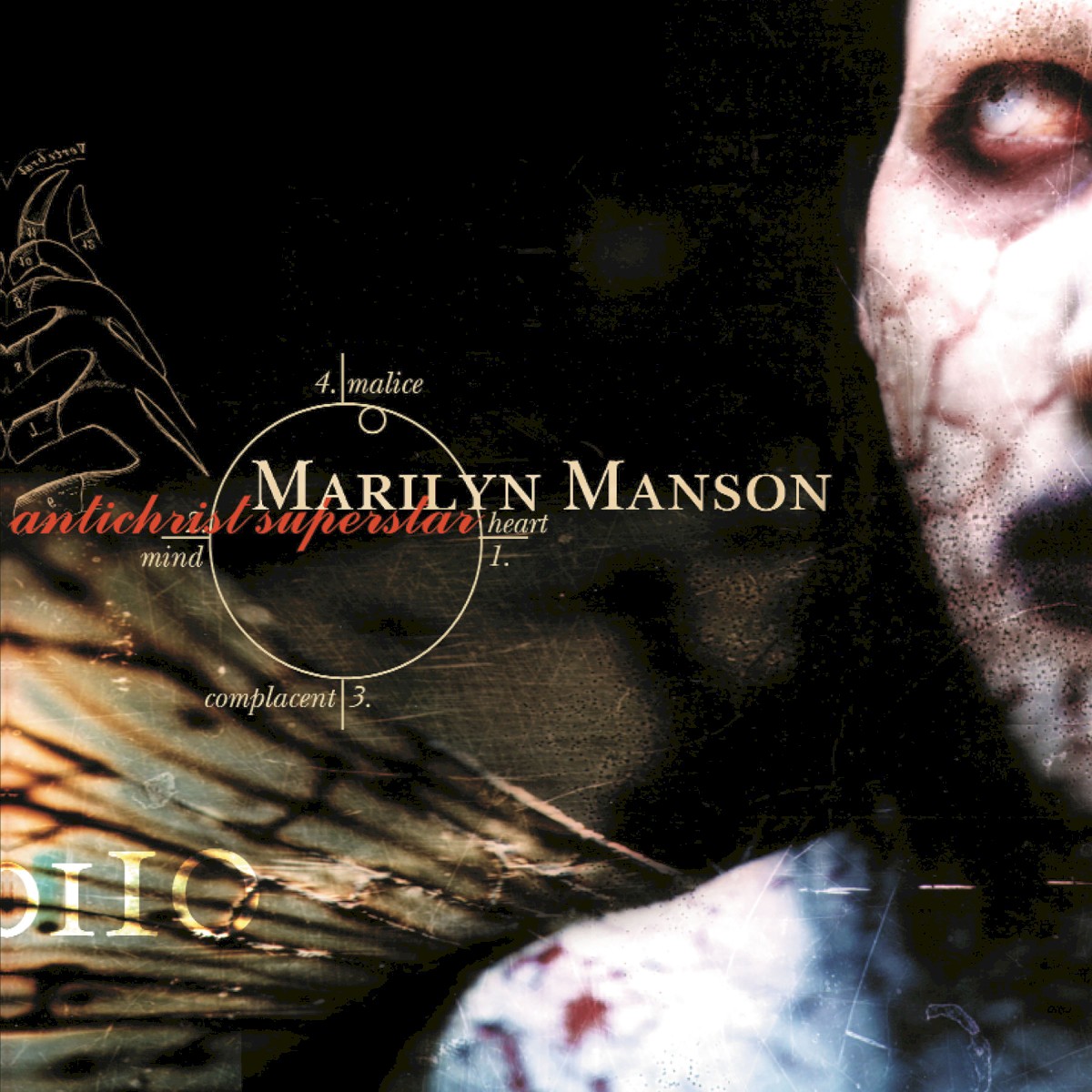
Marilyn Manson's second album, a rock opera in three cycles made in Trent Reznor's New Orleans studio, reached #3 in America and a Senate hearing. It's better built than it is written.
- Released
- 8 October 1996 (US, Nothing/Interscope); 14 October 1996 (UK); 18 December 1996 (Japan)
- Label
- Nothing Records / Interscope Records
- Producer(s)
- Trent Reznor, Dave Ogilvie and Marilyn Manson; Manson and Sean Beavan on 'Dried Up, Tied and Dead to the World' and 'Kinderfeld'. Mixed by Sean Beavan
- Runtime
- 16 listed tracks in three cycles, 70:10 by the US CD's timings. With 82 short silent tracks and the hidden track at index 99, the disc plays for about 77 minutes
- Chart peak (US)
- #3 (Billboard 200), on 132,000 copies in its first week
- Chart peak (UK)
- #73 (Official Albums Chart, 1 week, chart dated 26 October 1996) · #7 (Official Rock & Metal Albums Chart, entering at its peak; 142 weeks across several runs)
- Certifications
- RIAA Platinum (11 December 1996); Music Canada 2× Platinum (18 September 1997); BPI Gold (22 July 2013). The label claims 7 million copies worldwide
- Awards & honours
- No Grammy nominations; the band's first came for 'The Dope Show' at the 1999 ceremony. The video for 'The Beautiful People', directed by Floria Sigismondi, was nominated at the 1997 MTV Video Music Awards, including for Best Rock Video, and won nothing
The panic of 1996 and 1997 has stood in for this record ever since. Heard on its own terms, it's a superbly constructed CD carrying 16 songs where 12 would have done.
Put the original CD in a player and the display keeps counting after the music stops. The 16 listed songs end with 'Man That You Fear'. Then come 82 tracks of silence, most of them 4 seconds long, and at index 99 an untitled track of 1:39. Nobody stumbles on that by accident. Someone built it, the way someone built the slip-case around the disc. On the front is a veined, shirtless figure the designer calls the worm. On the back is the same man in a suit and tie. P.R. Brown told Revolver the package needed two covers to show that change.
That care is the first thing to hear on Antichrist Superstar, and the last thing anyone remembers about it. It came out on 8 October 1996, went to #3 in America, and ended up in a Senate hearing. Since then the panic has done the talking for it. Listen past it and the case is narrower than either side made it. This is an exceptionally well-made album, sequenced in three named cycles and produced with real precision. The songs are another matter, and the best of the 1996 reviews already said so.
Greg Kot panned it in the Chicago Tribune as 'recycled Alice Cooper', fused with production moves borrowed from Ministry and Nine Inch Nails. Yet he told readers to ignore the vocals and hear the music, which he said Reznor and Dave Ogilvie had distilled 'to its seething essence'. Lorraine Ali liked it far more in Rolling Stone, calling it 'an alluringly nasty piece of work'. She also wrote that some of the songs were 'just too flat', and that the album should have been compressed. Jim Farber gave it a B in Entertainment Weekly, and heard industrial rock from 1990 with riffs out of old Skinny Puppy. So the sound had its doubters too. But all three doubted the writing: Kot the words, Ali the flat songs, Farber the borrowed riffs. Thirty years on, that's still where the record is weakest.
The ambition was the point. It's a rock opera about a creature that rises to power and destroys the world. The title comes from Jesus Christ Superstar, and the ideas lean on Nietzsche. Manson told Rolling Stone's Neil Strauss that it grew out of dreams of the world ending, with him the only one left. The moment gave it a target. In its first week it sold 132,000 copies, and one place below it on the Billboard 200 sat Nirvana's posthumous live album. Ali called the band 'a volatile reaction to five years of earnest, post-Nirvana rock', and that's a fair account of what the record was for.
It was made at Nothing Studios, an old funeral parlour on Magazine Street in New Orleans that Reznor had bought in April 1995. How long it took depends on who's counting. Strauss wrote that it was 'recorded during eight months with Reznor in New Orleans'. Manson, interviewed by Paul Semel in August 1996 on the day he finished, said he'd lived in the city for almost 5 months. In September MTV News reported him telling Australian music press the work had been 'a very trying experience', and that he'd experimented with drugs, pain and sleep deprivation. Of Reznor he said: 'Sometimes we work very closely, sometimes we don't talk at all.' The sleeve lists Reznor as a co-producer on all but two tracks.
The band that started the record didn't finish it. Scott Putesky, who played as Daisy Berkowitz, had co-founded the group in South Florida. He co-wrote the music of four of these songs. In September 1996 Manson said he'd left at the start of recording. Putesky's own account, given to New Times, is harsher. He says he was shut out of sessions and his gear was destroyed. Then he called a band meeting and quit. The same paper dates his exit to May 1996. He sued in January 1998 for $15 million and settled that October on confidential terms. The writer the album leans on instead is Twiggy Ramirez, credited on the music of 13 of the 16 songs.
The production team changed too. Manson wrote in his 1998 memoir that Ogilvie, who had co-produced Skinny Puppy's records, was fired. He says Sean Beavan replaced him, and that the two of them reworked much of the album in the building's second room. Reznor, meanwhile, was working on the Lost Highway soundtrack. The sleeve keeps Ogilvie's production credit on most tracks. It gives Beavan the mix of every track, and a production credit on just two. Those two, 'Dried Up, Tied and Dead to the World' and 'Kinderfeld', aren't parked together as a side project. One sits in the middle of Cycle I and the other closes Cycle II. Four producers and a split line-up were made to serve one plan, and the plan is the real achievement here.
The opening is a joke about authenticity. 'Irresponsible Hate Anthem' is staged as a live recording, which Ali called a 'mock-live opener'. According to Guitar World, the booklet dates that concert to 14 February 1997, months after the album came out. Zim Zum, who joined after the sessions, is credited with live guitar on it. Then 'The Beautiful People' goes the other way. Manson told Kerrang! he tapped the beat out on the floor and had the drummer copy it on a drum machine. The song came together in a day. Ramirez wrote the riff, and Manson doesn't sing until 0:44. Nothing else on the record is this plain, and few songs here are this good.
The middle cycle is where the production does the most work. 'Cryptorchid' is Madonna Wayne Gacy's piece. He wrote the music and plays the drums, and Reznor adds Mellotron. Stereogum, ranking it sixth among Manson's ten best songs in 2015, heard the vocals deadpanned through filtered microphones and a vocoder. The singing stops at about 1:31 and comes back 12 seconds later. 'Deformography', one of three songs Reznor co-wrote, goes about 22 seconds without a sung line from 2:46. In both, the arrangement has to hold the song while the voice is gone, and with a strong idea underneath it can. Then the cycle sags. 'Mister Superstar' and 'Angel with the Scabbed Wings' are the two songs Putesky said in 2011 he'd cut. The production is just as careful there, but it can't make thin songs stronger. That's where Ali's complaint about flat songs lands hardest.
The last cycle carries the story's climax, and it's uneven. The title track takes 52 seconds to reach its first vocal, and on tour it was staged as a rally. '1996' is catchier. By Putesky's account, its riff was lifted from 'She's Not My Girlfriend', a Spooky Kids song built on a riff by former bassist Gidget Gein, and there was legal action over it. 'Man That You Fear' closes the album. Its last sung line ends at about 4:31, leaving 1:39 of music to wind the story down. That's 16 songs in 70 minutes. Putesky said in 2011 it'd have had more impact as '12 songs instead of 16'. He had a point, and the length is part of what's wrong with the writing.
Then the record stopped being a record. On 10 December 1996, William Bennett, Senator Joseph Lieberman and C. DeLores Tucker held a press conference against Seagram and MCA, which owned half of Interscope. They quoted the album's lyrics, but their target was the label's whole roster, Snoop Doggy Dogg and Tupac Shakur included. That month the Utah State Fairpark's president cancelled the band's show booked for 11 January, and the band played a ski resort instead. On 6 November 1997 a Senate subcommittee held a hearing on music and violence. Raymond Kuntz, whose 15-year-old son Richard had died in December 1996, held a copy of the album. Richard's friends, he said, had told him 'The Reflecting God' was his favourite song. Nobody in that room was asking whether the record was any good.
None of that tells you much about the music, and Britain shows why. There the album spent a single week on the main albums chart, at #73. But it entered the UK Rock & Metal chart at #7 in its first week. It was back at #7 in June 1997 and again in January 1999, and it logged 142 weeks on that chart across several runs. 'The Beautiful People' reached #18 in Britain nearly 8 months after the album came out. Away from the hearings, it behaved like a cult record: a narrow audience that held on for years. In America it had sold 1.9 million copies by 2010, the band's biggest seller there. The next album, Mechanical Animals, went to #1.
Its documented legacy is thinner than its fame. It became the first-released part of a trilogy with Mechanical Animals and Holy Wood. As Loudwire put it in 2016, the three play out in reverse order, so this is the end of the story, told first. The song travelled further than the album. Lester Bowie's Brass Fantasy covered 'The Beautiful People' in 1998, Christina Aguilera sampled it in 2010, and WWE SmackDown opened with it from 2001 to 2003. After Columbine in April 1999 the band was falsely tied to the killers and cancelled its remaining US dates. Dave Cullen's book on the shootings found the pair disliked Manson's music. Critics never settled. Robert Christgau graded it a dud. Stephen Thomas Erlewine, at AllMusic, called it the definitive statement while finding the guitars anaemic.
So it's a good record with a weak stretch, and both halves of that verdict matter. The case for it is the construction: three cycles, a hidden track and a package with two covers. Even Kot, panning the album, told readers to listen to what the producers had done. The case against is the writing. Two songs in the middle sag, and one riff is in dispute. At 16 songs, the album crowds out its own best work. 'The Beautiful People' and 'Cryptorchid' belong among the band's finest songs. The production lifts the songs with a strong idea in them, and it can't rescue the thin ones. Play it once as it was designed, on the CD, through the silence to track 99. Then admit that the case for it rests on the construction more than the songs.
Pressing guide — the one to own
There was no vinyl in 1996. As of October 2026, all 51 catalogued versions dated to that year are CDs and cassettes. So the original to own is the US CD, Nothing/Interscope INTD-90086, in its printed slip-sleeve: the worm on the front, the suited figure on the back. The first vinyl came from Simply Vinyl in Britain in November 1998, catalogue SVLP 055, a 180g 2×LP in a gatefold. Two genuine retail versions exist, besides a white-label test pressing. One has 'shock symbol' labels and etched runouts; the other has plain white labels and stamped runouts. Plain labels are not a counterfeit tell.