
Deep Dive
Back in Black
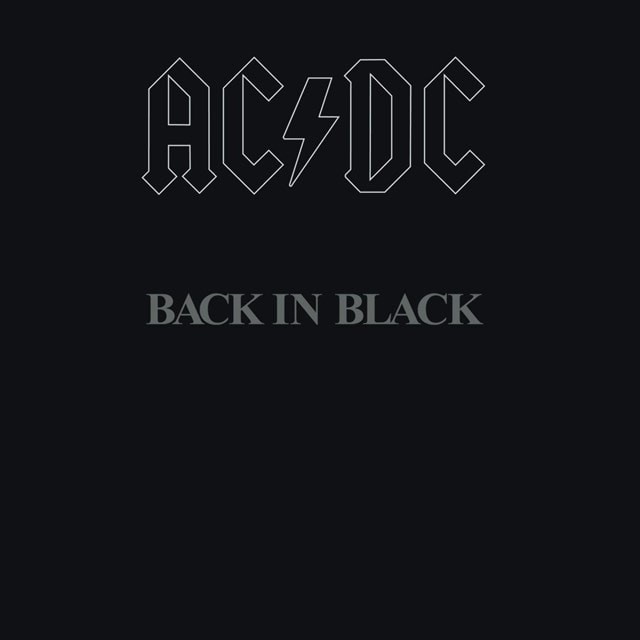
Back in Black by AC/DC (1980) — what a copy is worth and which pressing to own, in a full Lead-In dossier: AC/DC lost Bon Scott in February 1980 and had a new singer and a finished album by May.
Back in Black by AC/DC (1980) — what a copy is worth and which pressing to own, in a full Lead-In dossier: AC/DC lost Bon Scott in February 1980 and had a new singer and a finished album by May.
AC/DC's first album after Bon Scott's death, made with a new singer within months. It's a feat of recording and playing more than of writing, and it invented almost nothing.
Back in Black is usually told as a story of grief and resurrection. The grief is in the sleeve and the bell. The rest is a superbly recorded band playing songs it already knew how to write.
Before AC/DC played a note at Compass Point, Tony Platt walked round the studio hitting a snare drum. The room in Nassau was dead, with a low ceiling. In one spot the drum sounded louder and fuller than anywhere else. Platt later found out why: there was space above the ceiling there. That's where the kit went, and the guitars were set up around it. The engineer told the story to Sound On Sound in 2014, and it's the best way into Back in Black. The sound of this record was found in a room, by people listening hard. Very little of it was invented.
That isn't how the album is usually told. The usual story is grief and resurrection. A band loses its singer in February 1980, finds another, and by the summer has made one of the biggest-selling records in history. All of that happened. But the grief lives almost entirely in the black sleeve and in the bell that opens side one. The songs are about sex, drink and noise, and Johnson has said the whole point of the album was to celebrate Scott's life. What makes Back in Black great is the recording and the playing. What holds it back is a pair of lazy songs, some lyrics that have aged badly, and a band with no interest in doing anything new. It deserves admiration. It doesn't need worship.
Bon Scott died in London on 19 February 1980, after a night out drinking. He was 33. The coroner recorded death by misadventure. Malcolm and Angus Young had been writing new songs at a rehearsal room called E-Zee Hire, and Scott had dropped in days before. On the afternoon of 19 February, Mutt Lange, who'd produced Highway to Hell, took the call at Battery Studios, where he was making another band's album with Platt. The band briefly thought about stopping. At the funeral in Fremantle, Scott's father gave Malcolm his blessing to carry on. Malcolm pushed his brother back to work. In March, Angus told Sounds they didn't want a singer who'd imitate Scott.
The replacement came quickly. Brian Johnson was 32, the former singer of the glam band Geordie, who'd had a British top-10 hit in 1973. He was running a small business fixing windscreens and fitting vinyl roofs on cars. Lange suggested him, and a fan in Cleveland wrote to the band with the same idea. Scott himself had praised Johnson to Angus years earlier. Johnson sang 'Nutbush City Limits' and 'Whole Lotta Rosie' at Vanilla Studios in Pimlico, was called back, and by early April he was in the band. For the title track, he was told, the words should celebrate rather than mourn. He later called the whole album a good rock record in memory of Bon, "without the slabber". That attitude explains the record. It also explains why the record says so little about the man it remembers.
They flew to Nassau in April. Customs held the band's gear while storms battered the island. Johnson remembered the living quarters as "little concrete cells". Malcolm said they sat up through the nights with rum and coconut milk, and that a lot of the lyric ideas came from those nights. Accounts of the stay run from 6 to 7 weeks. Platt recorded the backing tracks as complete takes, two guitars, bass and drums, with no guide vocal. Johnson sang later, alone at the back of the room. Lange had him do it a verse or a chorus at a time, so he hardly heard a song whole. "That's the way 'Mutt' keeps you interested," Johnson told Classic Rock in 2000. The method shows in the result: the four players were recorded as one machine, and the voice was laid over it afterwards.
Platt built each guitar sound song by song, swapping Marshall heads and cabinets, and kept the amps only as loud as they needed to be. Malcolm's rig was screened off on one side of the drums and Angus's on the other. The band didn't like to hear effects, so reverbs and delays were tucked in where nobody would notice them. Angus played his solos through a radio transmitter, then kept playing rhythm to the end of the take so the track didn't sag. You can hear what that care buys on the title track. It rests on Malcolm's riff, which Angus says his brother carried around for about 3 weeks before asking to put it on tape. Johnson comes in at 0:26. Malcolm heard the song as something new, "soul meets rock'n'roll", with phrasing that came from jazz and scat singing. Lange couldn't see the point of the song. It's the best thing on the album, and that tells you whose instincts the record runs on.
'Hells Bells' is the one place the record mourns, and it does it without words. Malcolm counted the title track as a tribute too, but that one is a show of defiance. The bell was Malcolm's idea. John Taylor & Co in Loughborough had 7 weeks to make it: a bronze bell 48 inches across, tuned to E, weighing 2,318 lb with the band's logo on it. While it was being cast, Platt tried to record a stand-in, the big bell in the town's war-memorial carillon. Pigeons and traffic made a clean recording impossible. So he recorded the real one at the foundry with Ronnie Lane's mobile studio, while the bellmaster Mike Milsom struck it. At the mix in New York the tape ran at half speed, which dropped the note an octave. It tolls 13 times, and Johnson doesn't sing until 1:27. Milsom says there was "no doubt at all" that it was a funeral bell for Scott. It's the album's grief, cast in metal and then left behind.
Elsewhere the record runs on performance. Angus re-recorded his 'Shoot to Thrill' solo during the mix at Electric Lady. Platt struggled to match the sound, because the radio rig wasn't with them in New York. 'You Shook Me All Night Long', the first single, is the closest the band came to pop. David Fricke called it surprisingly commercial in Rolling Stone that November. Lange thought it had too many words. Malcolm overruled him, and Johnson came away calling Malcolm the captain of the ship. The closer, 'Rock and Roll Ain't Noise Pollution', was written in about 15 minutes, once nine songs were done and the album was one short. Johnson ad-libbed its spoken opening in one take, smoking, because Lange asked for something. His only real complaint was the high notes on 'Shake a Leg', some of which, he said, would never be heard again.
Not all of it holds up. Side one sags in the middle. 'What Do You Do for Money Honey' and 'Given the Dog a Bone' sit back to back, and they're the same leering joke told twice. The first is the oldest title on the record, a George Young idea from the Powerage sessions. Robert Christgau gave the album a B−. He liked Angus's riffs but found them inconsistent, and he found the sex songs unimaginative. Barry Walters, who liked the record, still flagged the meanness of those two songs in Rolling Stone in 2002. In 2011 the Observer's Kitty Empire named it her favourite album. In the same piece she faulted 'Let Me Put My Love into You' on consent, and noted that the record celebrates the excess that killed Scott. Those criticisms land. A band this careful about sound was careless about what its songs said.
The other limit is invention. Fricke's rave measured the record against Led Zeppelin II and the early Rolling Stones. He compared Johnson to Robert Plant, Ian Gillan and Noddy Holder. That's praise for doing an old thing better. Christgau put the same point less kindly, casting AC/DC as the primitives taking over from Aerosmith. Nothing on Back in Black would have puzzled a hard-rock fan in 1972. In 2019 Pitchfork heard a voice without Scott's nuance and character, and that's fair: Johnson plays one character, and plays it well. What it added was finish: a five-piece band recorded clean and exact, with nothing in the way.
The market didn't mind any of that. Back in Black went straight in at #1 in Britain in August 1980 and stayed there 2 weeks. In America it entered the Billboard chart in August and peaked at #4 on 20 December 1980. By the band's count, that first run lasted 131 weeks in a row. 'You Shook Me All Night Long' reached #35, the band's first US Top 40 hit, and AC/DC have never had a Top 20 single there. In January 1981 John Kalodner, who'd signed them to Atlantic, told the Los Angeles Times the album was selling on word of mouth. The RIAA certified it 27× Platinum on 21 August 2024. World sales are usually put at around 50 million, but nobody has audited that number.
Its influence is easier to document as a sound than as an idea. Pitchfork notes that Nashville studios used it to test their acoustics. Slash has been quoted saying it saved rock'n'roll. Among critics, though, its standing has drifted. Rolling Stone's list of the 500 greatest albums had it at #73 in 2003, #77 in 2012 and #84 in 2020. That slow slide feels about right. This is a reference record, the one studios reach for when they want to test a room. It didn't change what anyone thought rock could be.
So take the legend apart and keep most of what's left. The production and the playing are as good as hard-rock recording got in 1980. 'Hells Bells', 'Shoot to Thrill' and the title track are as strong as anything the band made. Two songs on side one are filler, a few lyrics have aged badly, and none of it is new. Back in Black is a very good record, made with great care by a band in the worst position a band can be in. Admire it for that. Just don't take its sales as proof that it's the greatest rock album ever made.
The home pressing is the Australian original on Albert Productions, APLP.046, released on 11 August 1980. It has a red label with yellow strobe marks, an embossed sleeve and a fold-out sheet of pictures and credits. It was made by EMI (Australia) in Sydney and cut at EMI Studios 301, with the runouts stamped 'APLP 046 A MAXICUT' and 'APLP 046 B MAXICUT'. In America the original is Atlantic SD 16018, mastered and cut by Bob Ludwig at Masterdisk. Every side-A runout documented for the 1980 US copies from all three plants has both Ludwig's RL initials and the MASTERDISK stamp. So the Ludwig cut is the standard US original, not a variant.
© The Lead-In · an independent, reader-supported music publication.