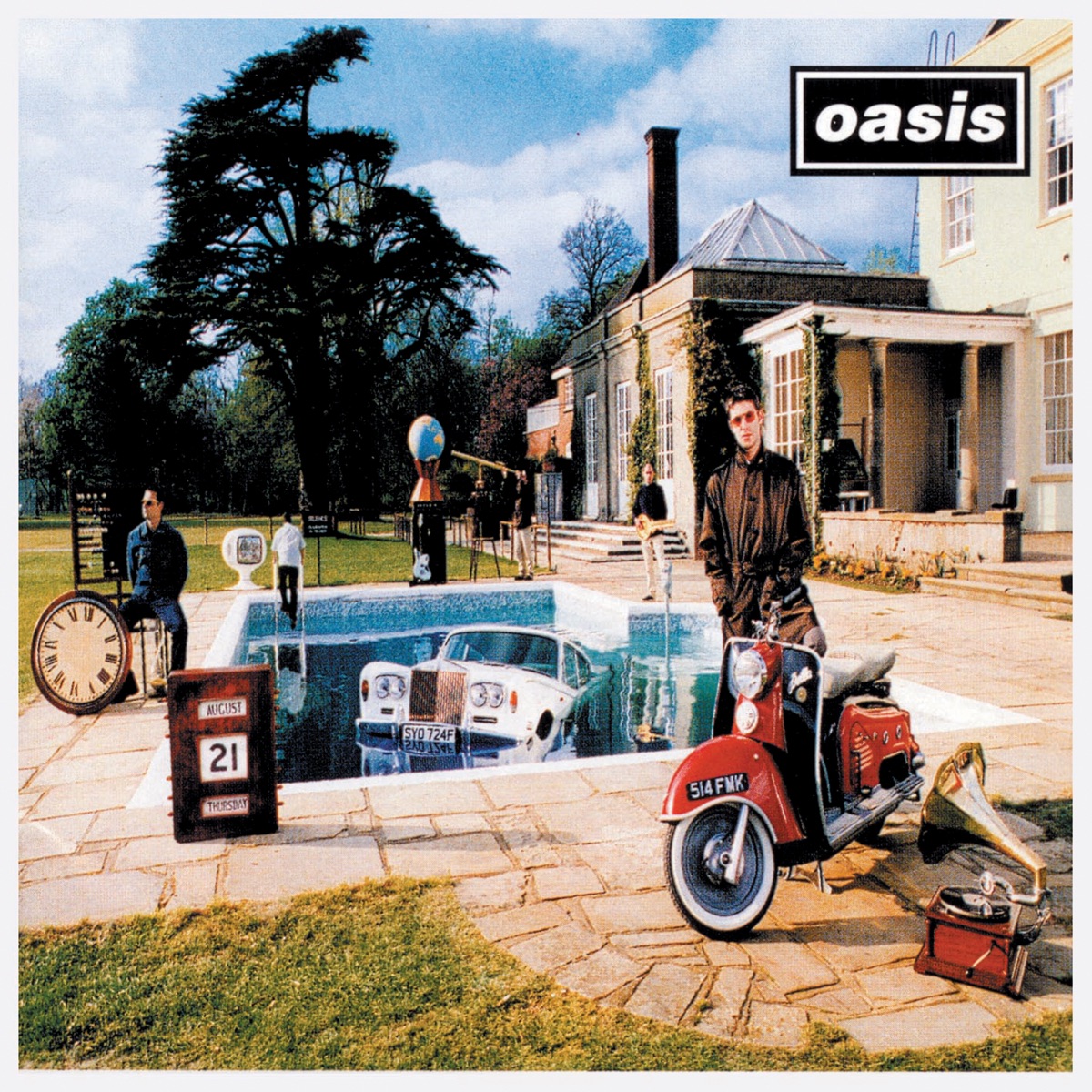
Oasis's third album sold 424,000 copies on its first day in 1997 and became Britpop's cautionary tale. The usual explanation for what went wrong is only half right.
- Released
- 21 August 1997 (UK, Creation); 26 August 1997 (US, Epic)
- Label
- Creation Records (UK); Epic (US); Helter Skelter (Europe)
- Producer(s)
- Owen Morris and Noel Gallagher
- Runtime
- 71:31
- Chart peak (US)
- #2 (Billboard 200, chart dated 13 September 1997), 770 copies behind Puff Daddy's No Way Out
- Chart peak (UK)
- #1 (Official Albums Chart), 5 weeks at the top
- Certifications
- BPI 7× Platinum (May 2026); RIAA Platinum (November 1997); Music Canada 2× Platinum (August 1997)
- Awards & honours
- Nominated for British Album at the 1998 Brit Awards, which The Verve's Urban Hymns won. The UK's biggest-selling album of 1997, with 1.47 million copies
The legend says cocaine and a studio with no brakes buried great songs under guitars. The Mustique demos tell a different story: the songs were already long, and mostly familiar, before anyone pressed record. The studio only made them heavy.
In 2016 Noel Gallagher went back to the multitrack tapes of Be Here Now, meaning to re-edit the whole album. He got as far as the first song. 'D'You Know What I Mean? (NG's 2016 Rethink)' runs 7:23 against the original's 7:42. Most of what changed is that the doubled guitars came out, so you can hear the strings and the bass. Then he stopped. His reasons have varied with the interviewer. Once, the tapes simply didn't grab him. Another time, he decided that editing a record meant to be excessive missed the point. Either way, the man best placed to rescue the album sat down to do it and found 19 seconds.
That small number is the most useful fact about the record. For nearly 30 years the story has been the same. Cocaine and a studio where nobody said no took a set of great songs and buried them: too long, too loud, too many guitars. Half of that is true, and the demos Noel made on Mustique in 1996 tell you which half. The songs were long before anyone booked Abbey Road. Most of them were the kind of song Oasis had already written twice. What the studio added was weight.
It was made too soon, and Noel has said so himself. In August 1996 Oasis played two nights at Knebworth to 250,000 people, from 2.5 million ticket applications. (What's the Story) Morning Glory? was on its way to 5.2 million sales in Britain alone. A month later Noel walked off the American tour in Charlotte, North Carolina. By early October the band were at Abbey Road, starting the follow-up. Looking back in 2016, he said they should never have made the record then. Morning Glory hadn't run its course, and the industry veterans around them should have spoken up. Nobody had a commercial reason to. The BPI certified Be Here Now 5× Platinum on 31 July 1997, 3 weeks before anyone could buy it, on 1.5 million copies shipped to shops.
The writing was finished, and 10 of its 11 songs demoed, in the months before Knebworth, at Mick Jagger's villa on Mustique. Owen Morris flew out and set up a Tascam digital eight-track in a house on the island. Over about a week he recorded Noel with a drum machine, Noel playing guitar, bass and percussion himself. Johnny Depp dropped by to play slide guitar on 'Fade In-Out'. Some of the songs were older than the trip. Noel says he taught the band 'All Around the World' in 1992, and a demo of 'Don't Go Away' survives from a Tokyo soundcheck in September 1994. Morris wrote in 2015 that the Mustique tapes were the last good recordings he made with Noel.
Those tapes settle the argument about length. The 10 songs Noel demoed on Mustique run to about 55 minutes. The same 10 on the album run to about 62. Nearly 3 of the extra 7 minutes belong to a single song, 'All Around the World', which grew from 6:31 to 9:20. Two songs came out of the studio shorter than they went in: 'My Big Mouth' lost 15 seconds and 'Stand by Me' lost 5. The album runs 71 minutes, against 52 for Definitely Maybe and 50 for Morning Glory. That's mostly because Noel wrote 71 minutes of music. The edit that didn't happen should have happened at the writing desk, and that's harder to blame on anyone else.
The sessions moved from Abbey Road to Ridge Farm in Surrey and on to AIR in London, with work at Master Rock and Orinoco along the way. The sleeve dates them from November 1996 to April 1997. The people in the room describe chaos. Noel compared the Abbey Road weeks to Animal House. Morris told Q in 2007 that money was the only reason anyone was there, and described heavy drug use, fights and poor recordings. Noel told the same magazine a decade later that he was on cocaine most of the time, and assumed the songs would keep coming forever. Dorian Lynskey's 2016 history of the record in the Guardian counts up to 30 layers of guitar on some tracks. By one participant's account, the parts outgrew a single tape machine.
You can hear the method in the first minute. 'D'You Know What I Mean?' spends more than a minute on backwards tape and a slowed drum loop lifted from N.W.A's 'Straight Outta Compton'. Liam doesn't sing until 1:07. It's a statement of scale, and the one time on the album that scale is the point. 'My Big Mouth', which the band had first played at Knebworth, is where the method stops paying. Its chorus arrives at 1:16, and what arrives is mass: the same part recorded again and again and laid on top of itself. On the first two albums Oasis were loud with a shape, a lead line riding a rhythm part. Copies of one guitar part don't add detail. They add pressure. And 71 minutes of pressure is tiring in a way that 50 minutes of Morning Glory never is.
The songs that survive are the ones the method can't reach. 'Stand by Me' takes its time: two verses pass before the title arrives at 2:02, and the wait is what makes the chorus land. It's the best melody Noel wrote for the record. The strings, credited to Nick Ingman and Noel, give it somewhere to go that isn't louder. Lynskey hears the Mustique demo as close to 'Half the World Away', which tells you how little it needed. 'Don't Go Away', with Liam in at 0:26, is the album's one moment of exposure. Listeners have settled the question. By October 2026 'Stand by Me' had more than 430 million plays on Spotify, and 'Don't Go Away' more than 160 million. The title track had under 16 million.
'All Around the World' is the album's whole argument in one track. Noel had carried the tune since 1992, and it's a good one, stated plainly by the first chorus at 1:10. Then the song keeps going, climbing through key changes for minutes after the tune has said what it has to say. As a 9:38 single in January 1998, it became the longest song ever to reach #1 in Britain. Revisiting his own old review for the Guardian in 2020, Luke Holland called the album a preposterous hoot, with one exception: 'Magic Pie'. That's fair. Noel's only lead vocal on the album breaks for an instrumental passage at about 4 minutes, and never finds a reason to have left. 'It's Gettin' Better (Man!!)' and the title track are riffs with attitude and not much else. The first of them runs for 7 minutes.
Who made it sound like this is still argued over by the people who did. Noel said in 2016 that the band should never have mixed it themselves, and called the final mix terrible. Morris called it a disgrace, then changed his mind. Hearing his half-inch masters again when Ian Cooper remastered the album, he decided his mixes had been fine. The original CD, he concluded, had been let down in mastering. Liam blames Noel's insistence on producing. What nobody in the argument disputes is the playing. A year on from Knebworth, Liam sings every line as if the country is listening, which in August 1997 it was. The band behind him never falters. The performance is the record's real strength. It just has nowhere to put it.
Its importance is mostly about what happened around it. It sold 424,000 copies on its first day and more than 650,000 in its first three. That was the biggest opening week on the UK chart until Adele's 25 in 2015. In America it reached #2, 770 copies behind Puff Daddy's No Way Out. It also changed how records were sold to critics. Advance cassettes came with agreements forbidding reviewers to discuss them. Several reviewers have since said their verdicts were softened. Taylor Parkes says Melody Maker cut his most negative lines. Angus Batey, then reviews editor at Vox, says a superior went through his magazine's review line by line. Paul Du Noyer, who gave it five stars in Q, called it in 2016 the canary in the coal mine for a movement that wasn't going anywhere. Ten days after release Diana died, and the confident national mood the album had been built for went with her.
There's been a reappraisal of sorts. Batey argued in the Quietus in 2016 that it's the best Oasis album, and Parkes called it a fascinating document. Liam gave it 10 out of 10 in 2017, though he gave the first two albums the same. The reunion was the real test, and the record failed it. When Oasis returned in July 2025, two of the 23 songs in the Cardiff set came from Be Here Now. In the chart week of 17 July 2025, Time Flies was #1, Morning Glory #2 and Definitely Maybe #4. Be Here Now was at #89. The audience has made the edit Noel couldn't.
So the legend has the cause wrong and the verdict about right. Be Here Now isn't a great album ruined in the studio. It's a great band at full strength, playing long, heavy versions of a kind of song it had already written better. In the middle are two of Noel's best songs, 'Stand by Me' and 'Don't Go Away'. A third, 'All Around the World', earns its absurdity for about half its length. The production didn't cause the problem. It made the problem impossible to miss. Keep those three songs, and treat the rest as a record of what Knebworth did to Oasis's judgement. That's its value now: as evidence, more than as an album you'd choose to play from start to finish.
Pressing guide — the one to own
The prize is the 1997 fan-club box, issued only to members in an LP version (CRELP 219) and a CD version (CRECD 219). It comes with a photo booklet, 'The Recording Of Be Here Now', which according to its catalogue entry details where and when the album was recorded and mixed. The everyday original is the standard UK double LP, Creation CRELP 219, in a gatefold with two printed card inner sleeves. Check the runouts: copies cut by Mike Marsh carry 'MIKE'S-THE EXCHANGE', and the 2008 unofficial pressings that copy the catalogue number and barcode don't.