
Deep Dive
The Stone Roses
The Stone Roses by The Stone Roses (1989) — what a copy is worth and which pressing to own, in a full Lead-In dossier: The Stone Roses' 1989 debut entered the UK chart at #32 and took 9 months to reach #19.
The Stone Roses by The Stone Roses (1989) — what a copy is worth and which pressing to own, in a full Lead-In dossier: The Stone Roses' 1989 debut entered the UK chart at #32 and took 9 months to reach #19.
Remembered as the record where Manchester's guitars met acid house, the Stone Roses' 1989 debut is really something older: 1967 songcraft, played by a rhythm section that swings.
Its makers thought it wasn't loud enough, and they had a point. The songs survive a thin mix and a borrowed palette because of how Mani and Reni play them. It's a great record, though not quite the one its legend describes.
'Of course, John and Ian hated the record.' That's John Leckie, who produced The Stone Roses, talking to Mojo in 2024. Ian Brown and John Squire told him the drums and bass weren't loud enough, and that the guitar 'needed to be more devastating'. They'd been playing Public Enemy in the studio all the time, at full blast. Two polls have since named this the best British album ever made. The two men who wrote it thought it wasn't loud enough.
They were partly right, and the part they got right is the best way into the record. The legend says a Manchester guitar band caught the spirit of acid house and changed British rock. The album is older and plainer than that. It's 10 songs and one reversed tape, carried by a bass player and a drummer who swing. Most of its parts come from the late 1960s, and they're put together with great care. The songs and the swing are why it lasts. The thin sound its makers disliked, and a palette borrowed from 1967, are why it's a great record rather than the greatest.
The band formed in 1983, 6 years before the album came out. In 1987 they demoed 'Waterfall', 'She Bangs the Drums' and 'I Wanna Be Adored' for Warner Bros. The label passed. 'We don't hear any hits,' Brown remembered them saying. Rough Trade signed them for a single but didn't offer an album, so they ended up with Zomba and its Silvertone label. Brown told the Observer in 2009 that the four of them agreed on little. He and Mani liked reggae, and Squire and Reni liked Led Zeppelin. They weren't all into acid house. What they shared was Hendrix, late Beatles and Love's Forever Changes. 'You can hear those influences,' he said. You can, and they're both the record's strength and its limit.
How Leckie got the job depends on who tells it. Brown says Mani had an album by the Dukes of Stratosphear, XTC's psychedelic alter ego, told him to listen to it, and the band settled on its producer. Leckie thinks it was because Geoff Travis of Rough Trade, who'd sent him the demos, suggested him. Either way, the demos didn't impress him. They were badly recorded, too fast and soaked in reverb. So he rehearsed the band, rearranged the songs and gave them intros, outros and steady tempos. There was no pressure to prove themselves, he has said, because 'they knew they were good'.
The sessions ran from June 1988 to February 1989 across four studios. They were Battery in Willesden, the Kinks' studio Konk in north London, Rockfield in Wales and Coconut Grove in Stockport. Battery shared a building with Dreamhire, an equipment hire company the record company owned. The band could try any guitar or amp they liked. They always went back to what they had, Leckie says, 'because that's the sound'. Squire made most of the album on a Stratocaster through a Fender Twin Reverb. At Rockfield he set up a Fostex 16-track in his bedroom and spent days working out parts. Brown later called the recording 'dead easy, because we knew the songs inside out'. You can hear that preparation all over the record.
The record opens by making you wait. Leckie says they always knew 'I Wanna Be Adored' would start the album, and it's a bold choice for a debut. The bassline that opens it gathers slowly, and Brown doesn't sing until 1:48, more than a third of the way in. When he arrives he sings low and level, close to a murmur. The song is nearly all mood and very little tune. It works because nobody behind him hurries. Robert Christgau, no fan, said in 1990 that it summed the band up. He was right about that. It's the sound of a group that assumes you'll still be listening.
The real engine is the rhythm section. Brown claimed in 2009 that they were 'the only band with a groove at the time'. That groove isn't a drum machine or a sampled break. It's Mani, a bass player who plays tunes, and Reni, a drummer who swings. Neil Kulkarni disliked most of the album when he reviewed the 2009 reissue for the Quietus. Even he singled out Reni's drumming and Mani's bass for praise. 'She Bangs the Drums' and 'Waterfall' are where all four lock together. Squire's guitar rings across the top, and the songs move forward without pushing. Then comes the album's one experiment. 'Don't Stop' is built on 'Waterfall' played backwards, with new percussion and new vocals over the top. The sleeve doesn't credit Leckie for it. It calls it 'Another Schroeder/Garage Flower production', and Paul Schroeder was the album's engineer. At 5:17 it's a clever trick that outstays its welcome.
'I Am the Resurrection' began as a joke. Reni said Mani used to play the riff of the Beatles' 'Taxman' backwards at soundchecks. The others played along for a laugh, then decided to do the joke song properly. Brown's last line comes at 3:05, and the band play on for 5 more minutes. On stage they had ended it in feedback and noise. Leckie told them that was boring on record: 'do something melodic that people will remember.' Mani said the end section was recorded in one take by him, Squire and Reni. The picked acoustic guitars of the last minute or so went on later, at Konk. 'I think you can tell because the drums sound different,' Leckie said. It's the best passage on the album, and the place where the craft and the swing finally meet at full strength.
Which brings us back to the complaint. Brown and Squire wanted the drums and bass louder, and the record gives them a case. Reviewing the 2009 remaster, Pitchfork said the original lacked range at the low end and had a tinny late-'80s drum sound. That's fair. The best thing on this album is its rhythm section, and the original mix keeps it neat and small. Leckie's clarity makes every song easy to follow. It also tidies up a band whose guitarist, by Leckie's own account, was 'much more rocking live'. The guitars chime where they could have bitten. That's the production's real cost: a record about swagger, mixed with good manners.
The other reservation is newness. Christgau gave the album a B– in the Village Voice in May 1990. He asked what the band did that the Byrds and Buffalo Springfield weren't doing better in 1967. It's a fair question, and the polls never answered it. 'Elizabeth My Dear' sets new words to the tune of 'Scarborough Fair'. Leckie says it took him years to notice that the vocal melody of 'Made of Stone' is the same as the Dukes of Stratosphear's '25 O'Clock'. The closer grew out of 'Taxman'. Most of this borrowing is done with taste. But the album's ideas are old ones, well chosen, and on side two the choosing starts to show. '(Song for My) Sugar Spun Sister' and 'Shoot You Down' are pleasant and slight. Either side of 'Made of Stone', side two loses its grip, and that's the record's one flat stretch.
It was neither an instant hit nor ignored. It entered the UK chart at #32 in May 1989 and went Silver that September, but by October it had dropped out of the Top 100. NME made it the second-best album of the year, behind De La Soul's 3 Feet High and Rising. The big push came from a song that isn't on it. After the album took off, Leckie says, Zomba told the band to do whatever they wanted. They spent 3 weeks at Sawmills in Cornwall on 'Fools Gold', built on the breakbeat from James Brown's 'Funky Drummer'. It entered the singles chart in late November 1989 and reached #8. Between December and February the album climbed from #53 to its first-run peak of #19. Much of the record's dance reputation belongs to that single. The album itself is a guitar record that happens to swing.
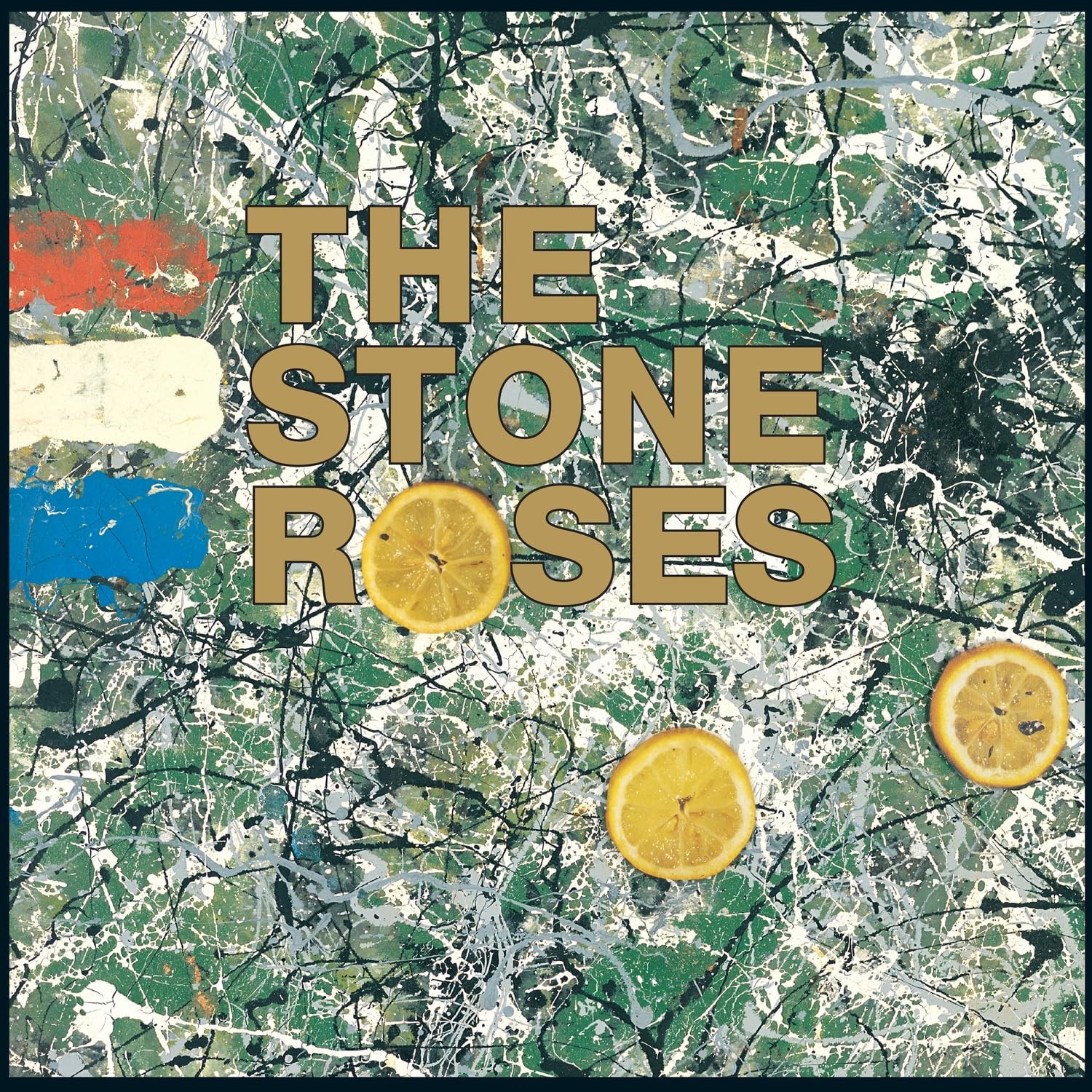
Then the band stopped. From the end of 1990 they were fighting Silvertone in court, and couldn't release new music for 2 years. They won, but the second album didn't arrive until late 1994, and Leckie walked out of those sessions after 3 months. The debut's standing grew in the gap. In 2004 an Observer Music Monthly poll of 100 musicians and critics named it the best British album, ahead of Revolver. NME's writers did the same in 2006. Liam Gallagher, who saw them at Blackpool and Spike Island, told NME in 2017 that their music was 'like another dimension'. Mojo says he cites seeing them play as the moment he knew he wanted to be in a band. Mani died in November 2025, aged 63. In the chart week ending 4 December the album re-entered at #25. At his funeral his coffin was decorated with its paint-splashed artwork, and 'I Wanna Be Adored' played as the cortege arrived.
So the legend has the cause slightly wrong and the value about right. The Stone Roses didn't invent a sound, and it never sounded as loud as its makers wanted. What it has is songwriting of a very high order and a rhythm section that makes even a tidy mix move. 'I Wanna Be Adored', 'She Bangs the Drums', 'Waterfall' and 'I Am the Resurrection' are as good as British guitar songs of the decade get. 'Don't Stop' and the soft middle of side two keep it from the very top. Brown worked on the 2009 remaster, 20 years after the original, and it went to #5. That suits this record. Its makers kept hearing what was missing, and listeners kept coming back for what was there.
The original is the 1989 UK Silvertone LP, ORE LP 502, pressed at the SNA plant on red-and-black labels with a deep 32mm pressing ring. The runouts read ORE LP 502 A2 and ORE LP 502 B2 with the SNA logo, and nothing else. Both embossed and flat gold lettering exist on SNA copies. Later 1989 copies were pressed by DFI from the same lacquers. Their runouts add a logo and '89-8' and strike through the SNA mark. Those DFI copies come on red-and-black labels as well as cream ones, so the label won't date a copy and the runout will. The printed card inner sleeve has band photographs on one side and Squire's painting 'Waterfall' on the other.
© The Lead-In · an independent, reader-supported music publication.