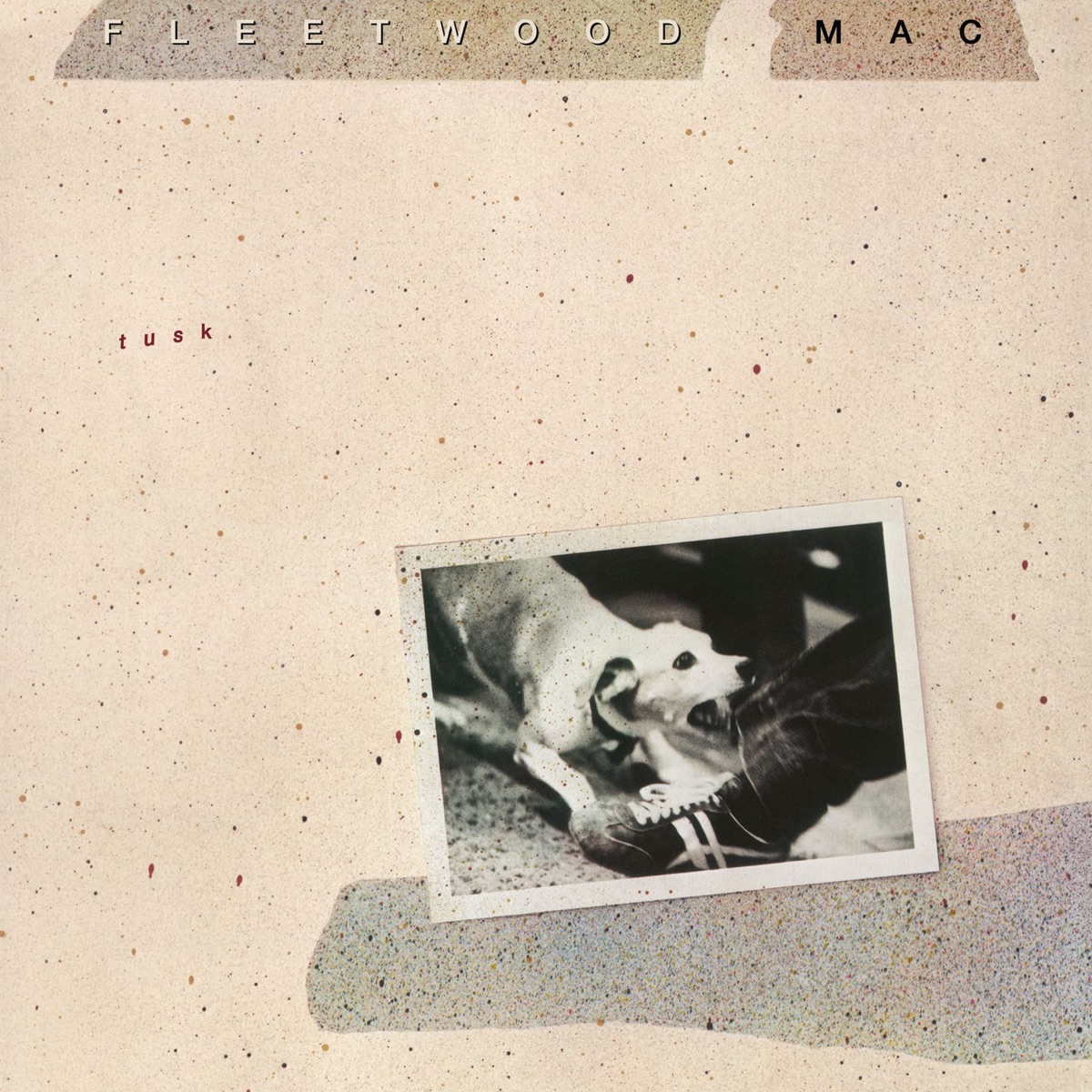
Fleetwood Mac's 20-song follow-up to Rumours cost more than $1 million and went to #1 in Britain. Buckingham's experiments make it thrilling; the sprawl is what holds it back.
- Released
- 12 October 1979 (US); 19 October 1979 (UK)
- Label
- Warner Bros. Records (US 2HS 3350; UK K 66088)
- Producer(s)
- Fleetwood Mac with Richard Dashut and Ken Caillat
- Runtime
- 73:45 (20 tracks, double LP)
- Chart peak (US)
- #4 (Billboard 200)
- Chart peak (UK)
- #1 (Official Albums Chart), 1 week
- Certifications
- RIAA 2× Platinum (October 1984); BPI Platinum (February 1980)
- Awards & honours
- Nominated for the Grammy for Best Album Package at the 1981 ceremony (art direction: Vigon Nahas Vigon). No wins
Tusk is the most inventive record Fleetwood Mac made, and the least whole. The double album gave three writers room to make their own records. That's why it still rewards a listen, and why it never quite works as one album.
On 4 June 1979, 112 members of the USC Trojan Marching Band played 'Tusk' in an empty Dodger Stadium. The idea was Mick Fleetwood's, after he'd heard a brass band in the French village of Barfleur. Dodgers third baseman Ron Cey arranged for the stadium to be donated. The USC drum major, Rodney Davis, conducted on the field while the band's director, Arthur C. Bartner, watched from a ladder. A film crew shot the day for the song's video, and Stevie Nicks twirled a baton. John McVie was away, sailing to Tahiti, so a life-size cardboard cutout stood in for him.
It's a good picture of the record. Robert Christgau noticed in 1979 that the three principals barely sing on each other's songs. John McVie has said it sounds like the work of three solo artists. In Rolling Stone, Stephen Holden reached for the Beatles' White Album, and called it 'a mosaic of pop-rock fragments'. That's the case against Tusk, and it's also the best reason to hear it. It's the most inventive record Fleetwood Mac made. It's also the least whole, and both facts have the same cause.
The cause was Lindsey Buckingham. By October 1979 Rumours had sold 13 million copies worldwide, according to Cash Box. Buckingham has said Warner Bros. wanted Rumours 2 and Rumours 3. He wanted something else. He has said he felt he was losing himself, and set out to subvert the norm. Mick Fleetwood later wrote that punk had made bands like theirs look like dinosaurs. He also wrote that Buckingham was drawn to the Clash, Talking Heads and Laurie Anderson. Ken Caillat, who co-produced the album, says Buckingham threatened to quit.
The band's answer was to make room for him. Fleetwood decided early that the new record would be a double album. Christine McVie has explained it as a way to keep Buckingham's experiments inside the band. So the split was built in from the start. Buckingham wrote nine of the 20 songs, McVie six and Nicks five. Fleetwood told Trouser Press that a double made no business sense but meant a lot artistically. It went out at a list price of $15.98. Warner told the band it would need to sell 500,000 copies just to break even.
Nobody agrees what Tusk cost. Cash Box called it a million dollars in the making in October 1979, and Ken Caillat later put the bill at $1.2 million. Either way, the money bought time. The 2015 box holds six versions of 'I Know I'm Not Wrong', dated across ten months. The last dated take on the whole set, from 13 August 1979, is one of them. Someone paid for that patience. What it bought doesn't sound expensive. It sounds close and dark.
On Buckingham's songs, the method was to make expensive tape sound cheap. A replica of his bathroom was built inside Studio D. He sang 'Not That Funny' in a push-up position over a microphone on the floor. On 'I Know I'm Not Wrong' he used a Kleenex box in place of the snare. On 'The Ledge' he tuned a guitar down an octave, into a bass's range. Fleetwood says his drums on 'What Makes You Think You're the One' went through the input of a JVC boombox, so they'd overload. Caillat describes the whole record as 'very dark'. He also says he buried some of Buckingham's harshest sounds in the mix. That tells you how far Buckingham was pushing. Holden heard the results as beautifully engineered basement tapes, with a debt to Buddy Holly.
The method works best when there's a tune for it to serve. 'Not That Funny' is a chanted title over a scratchy guitar, and the guitar plays the song out once the singing stops. Billboard's Ed Harrison said in 1979 that it sounded like a young new-wave band. 'That's Enough for Me' lasts 1:48, and about a third of it passes without a word. 'Walk a Thin Line' turns the same tools gentle, and Harrison picked it as Buckingham's most moving ballad. The title track is the method at full volume: a riff, a chant, a loop of drums and a college band. Stephen Holden called it the band's 'Revolution 9'. It still reached #8 in America and #6 in Britain.
Christine McVie and Stevie Nicks get less credit for Tusk than they've earned. Christgau thought Buckingham's spare sound exposed the limits of both women. Billboard's Ed Harrison disagreed about Nicks: he found her songs the most sensitive and emotional on the album, and called 'Storms' perhaps the most memorable track. 'Sara' is the best case, and even there the lines blur: Nicks plays tack piano, doubled by Christine McVie. It runs 6:26, and Nicks doesn't reach the title until nearly 3 minutes in. Fleetwood says he spent about 24 hours on brushes, placing phrases around her timing. That patience is the sound of the song, and it never hurries. It went to #7 in America, the album's biggest US hit. McVie's 'Think About Me' is the track that could have sat on Rumours, and it reached #20.
The quieter songs also hold the record's best surprises. Peter Green plays uncredited guitar in the long fade of 'Brown Eyes', after the last sung line. 'Never Make Me Cry' began as a piano ballad, according to Caillat's book. Buckingham then replaced the keyboards with layers of reverbed electric guitar. Holden counted 'Beautiful Child' among Nicks's two finest songs here, and 'Never Forget' among McVie's. Writing in Record Collector in 2016, Kris Needs argued that McVie's songs have aged best. On the evidence of 'Brown Eyes', he has a case.
The trouble is the whole. Christgau's point cuts both ways. Three writers who rarely sing on each other's songs give you an album that doesn't build from side to side. It changes channel instead. The running order keeps switching writers, so no mood settles for long, and each of the four sides runs between 16 and 20 minutes. Holden thought 'Over & Over' and 'Storms' over-produced, and the opener is a slow way into 74 minutes. Holden found 'Sisters of the Moon' close to impenetrable, and it stalled at #86 as a single. 'Honey Hi' is pleasant and slight. Harrison wrote in 1979 that the best of Tusk on a single LP would have been an incredible follow-up. He was right that there's a tighter record in here. The catch is that every listener would cut a different one.
It didn't flop, though a 2015 Ultimate Classic Rock retrospective still used the word in its headline. Tusk went to #1 in Britain and #4 in America, and the RIAA certified it 2× Platinum in 1984. About 4 million copies is the figure usually given. Next to Rumours, though, the label counted it a failure. The rollout didn't help. Stations in the RKO radio chain aired a leaked copy in the first week of October 1979, about a week early, and some played it in full. Warner won an injunction and hand-delivered promotional copies to radio on Monday 8 October. Rolling Stone adds that Warner also played the album in full on the Westwood One network the day before release. Fleetwood told Discoveries in 2004 that this was a 'milestone of stupidity', and blamed Warner for it. The reviews were warmer than the story. Cash Box called it the band's 'most adventuresome LP to date'. Music Week thought it lacked Rumours' impact.
Its standing has risen since, and not always through reverence. Camper Van Beethoven remade the whole album and released it in July 2002. Their bassist, Victor Krummenacher, said some of the band hated the original and thought they'd improved on it. Buckingham loved the remake anyway. Even inside the band, the verdict wavered: Christine McVie said in 1988 that she sometimes loved Tusk and sometimes hated it. Bob Stanley set out the case against Tusk in the Guardian in 2008, then argued it made more sense in 2008 than in 1979. Pitchfork gave it 9.2 in 2016 and agreed it was self-indulgent. Fleetwood has named it, with Then Play On, as probably his favourite of their records.
What did it change? Not much, at first. The band's own next move was a retreat: Caillat says Mirage, in 1982, 'was basically going to be Rumours II'. Tusk's influence arrived later, and from smaller bands. The New Pornographers' A.C. Newman put the melody of 'I Know I'm Not Wrong' into the end of 'To Wild Homes' in 2000. He has said Tusk haunted their music. A 2012 tribute album took six of its songs from Tusk, with Tame Impala covering 'That's All for Everyone'. That's a cult, and a real one, rather than a turning point.
So Tusk earns admiration, not reverence. The invention is real, and so is the craft. Caillat's dark, close sound still sounds like a decision. 'Sara', 'Walk a Thin Line' and the title track rank with the best things the band recorded. But it's a record you admire in parts. It doesn't hold across four sides, and the double album that kept the band together is the reason it can't. Make your own 10-song Tusk and you'll have a better album. You'll also have lost the thing that makes it worth arguing about.
Pressing guide — the one to own
There's no single prize here, because Tusk sold in millions. The original to own is the 1979 US double LP, Warner Bros. 2HS 3350. It comes in a single-pocket jacket with two printed card inner sleeves, and it isn't a gatefold, whatever some listings say. Every 1979 US, UK and German original examined was mastered at Capitol, and most have 'MASTERED BY CAPITOL' stamped in the runouts. Many US and German copies also carry Ken Perry's initials, 'KP', but the UK copies listed don't, so a missing 'KP' rules nothing out. The US plants were Capitol's own, in Winchester, Virginia and Los Angeles, told apart by symbols in the runout. For everything in one place, the 2015 super-deluxe box adds outtakes, The Alternate Tusk and two live discs.